
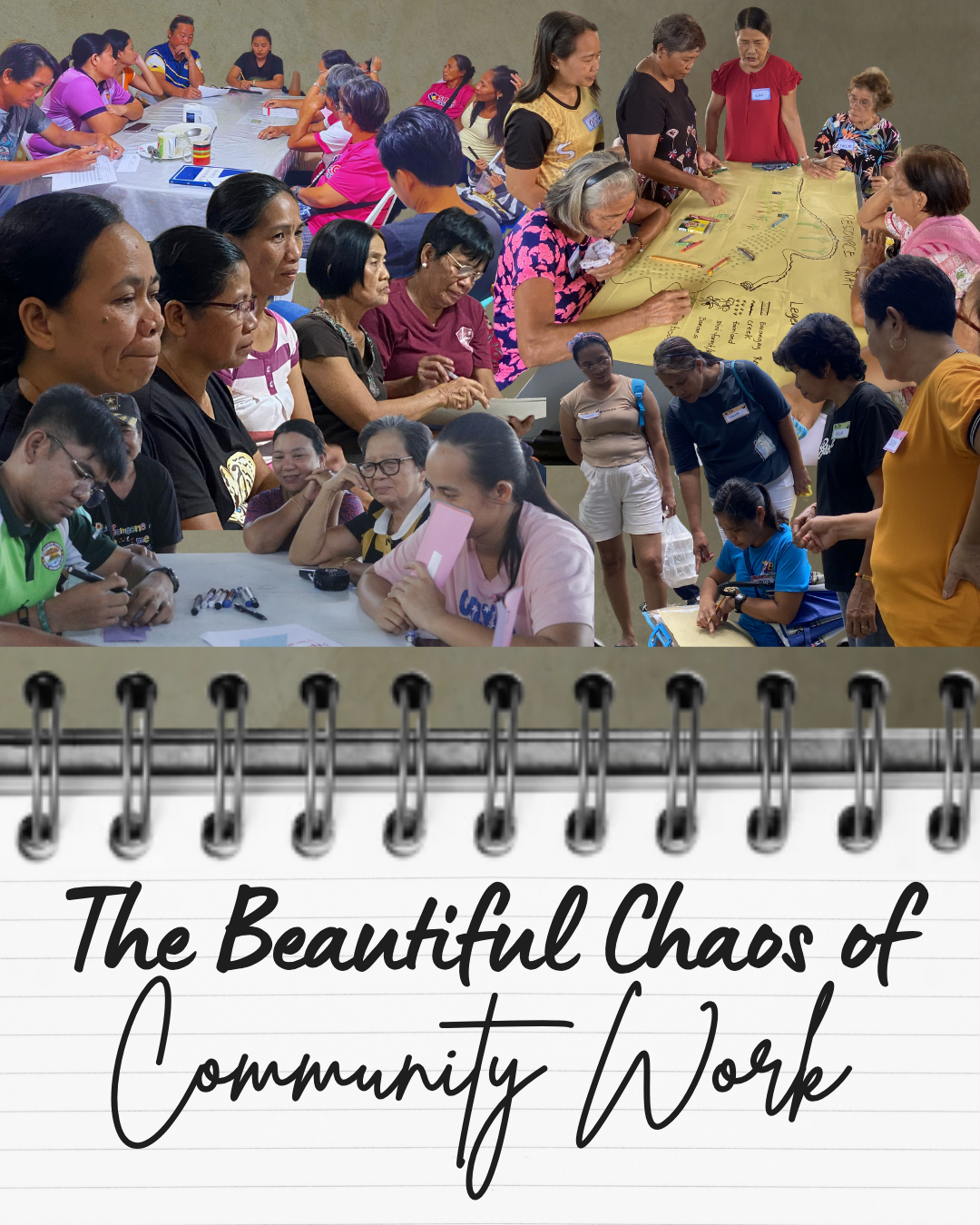
If there’s one thing last week’s SEA staff meeting made clear, it’s this: development work is not a straight line—it’s a winding road paved with good intentions, unexpected detours, and the occasional Zumba break.
What looks like a “weekly update” on paper is, in reality, a collection of lived moments—conversations under barangay halls, missed meetings that still mean something, and partnerships that test both patience and purpose. It is in these in-between spaces that real community work happens.
The Ground Tells the Real Story
In Bingawan, the immersion at the barangay level was less about ticking boxes and more about feeling the pulse of the community. Volunteers, barangay officials, health workers, and senior leaders each offered a piece of the bigger picture.
Because the truth is:
“You don’t measure community engagement by attendance sheets—you measure it by how willing people are to sit down, talk, and trust you.”
Even the absence of Ma’am Maryfe at the Heru Farm said something important. In development work, not every visit goes as planned—but the work continues, with or without perfect conditions.
There were glimpses of progress: a mushroom processing facility quietly sustaining livelihoods, seniors actively participating during payouts, and local development councils opening spaces for dialogue. These are not grand headlines—but they are real, grounded wins.
And yet, there was also tension.
The cooling relationship with the local leadership—where no formal disengagement exists, but enthusiasm has dimmed—reminds us of a difficult truth:
“Partnerships are not only built on agreements; they are sustained by consistency, trust, and presence.”
Still, the doors are not closed. Venues remain accessible, support systems are intact. In community work, sometimes progress means learning how to work within the silence, not just the support.
Where Energy Meets Intention
In Santa Barbara, the week unfolded like a well-paced rhythm of participation and planning.
The voices of senior citizens in Bagumbayan echoed a universal concern—health and mobility. But beyond the concerns was something more powerful: their willingness to show up, engage, and remain part of the conversation.
“A community that continues to participate, even in discomfort, is a community that refuses to be left behind.”
Capacity-building activities—from organizational development to strategic planning—highlighted a shift from passive membership to active leadership. Vision and mission statements were not just revised; they were reclaimed.
Hands-on trainings, like mushroom growing, grounded these plans in reality. Because in the end, strategies only matter when they translate into something people can hold, grow, or earn from.
At the same time, coordination efforts with agencies like DTI and MDRRMO showed that development is never a solo act. It is a network of relationships, constantly nurtured, sometimes delayed, but always necessary.
As one might put it:
“In community work, progress is not about speed—it’s about staying in motion.”
Building Systems, One Layer at a Time
New Lucena offered a different kind of narrative—one focused on structure, systems, and sustainability.
The needs assessment in Dawis revealed both gaps and potential: solo parents navigating registration challenges, PWD groups active but lacking formal organization. It’s a familiar scenario—communities rich in participation but still needing institutional support.
And yet, there is promise in that reality:
“You don’t start with perfect systems—you start with people who are willing, and you build from there.”
The General Assembly in Jelicuon Oeste became a defining moment. It didn’t just gather participants—it energized them. Plans were not blindly accepted; they were challenged, improved, and made more responsive. Irrigation ideas evolved into water impounding solutions—a clear sign that communities are not just beneficiaries, but thinkers and decision-makers.
Meanwhile, organizational strengthening continued:
- People’s Council reorientation and elections
- Strategic plan refinement
- Preparation for formal adoption and endorsement
But perhaps the most telling part of the week was the preparation for the medical mission.
Behind the scenes, it wasn’t just about services—it was about logistics, coordination, and problem-solving. Extension cords, transportation, volunteers, service providers—details that may seem small, but collectively define success.
As one staff candidly shared:
“In SEA, you don’t just plan programs—you plan everything, including who brings the extension cord.”
And still, despite the complexity, there was alignment. Leaders spoke with consistency, and more importantly, with conviction about the impact of SEA’s work.
“When different voices tell the same story of change, you know something is working.”
The Work Ahead: Momentum with Meaning
The coming days are no less demanding—strategic validations, first aid trainings, medical missions, partnership follow-ups, and institutional strengthening efforts across all municipalities.
But beyond the packed schedules lies something deeper: continuity.
Because development work does not thrive on one successful activity. It thrives on showing up again the next day, and the next, even when progress feels slow or uncertain.
A Closing Thought
What last week revealed is not just what SEA does—but how it does it.
With persistence in the face of uncertainty.
With humor in the middle of pressure.
With belief that small, consistent actions create lasting change.
In the end, community work is not defined by perfection. It is defined by presence.
“Between handshakes and headaches, missed meetings and meaningful moments, lies the real work—the kind that doesn’t always make headlines, but quietly transforms communities.”
And that is the kind of work worth continuing.

Leave a Reply