
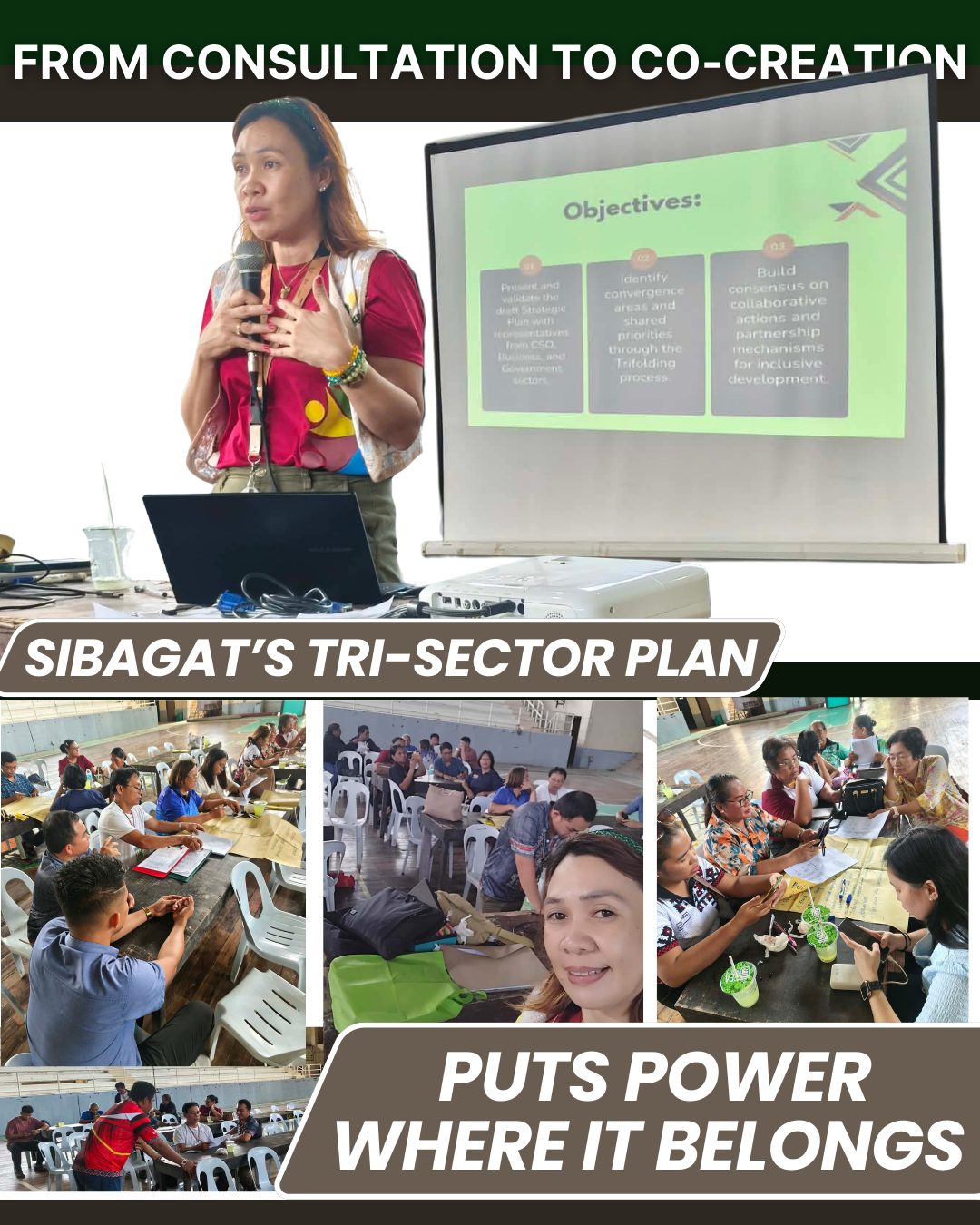
There are government reports that gather dust—and then there are those that gather people. What the Collective IPAT SIAD Team (CIT) of Sibagat has just placed before the Sangguniang Bayan is clearly the latter.
The submission of the Tri-Sector Strategic Planning Results is not just another item on a legislative agenda; it is the culmination of months of deliberate listening, negotiating, aligning, and occasionally disagreeing productively. In a governance landscape where “consultation” can sometimes mean little more than attendance sheets and photo ops, Sibagat’s approach under the Integrated Participatory Accountability and Transparency toward Sustainable Integrated Area Development (IPAT SIAD) initiative offers something refreshingly real: participation with teeth.
At its core, this effort is about power—specifically, the quiet but transformative act of sharing it.
Government representatives, civil society organizations, and business stakeholders did not simply sit in the same room; they worked through the difficult but necessary process of defining shared priorities. That sounds straightforward until you realize how rare it is. Each sector carries its own language, incentives, and blind spots. The government speaks in policies, civil society in advocacy, and business in viability. Getting them to agree is less like a meeting and more like translating three dialects into one actionable plan.
And yet, that is precisely what the CIT managed to do.
Guided by SEA Coordinator Ms. Avha Hilario, the process did not just produce a document—it produced a shift. Her role went beyond facilitation; it was about cultivating a mindset where stakeholders see themselves not as competing voices, but as co-authors of Sibagat’s future. Leadership, in this case, was less about directing traffic and more about ensuring that no voice was left stuck at the intersection.
The result is a strategic plan grounded in four deceptively simple principles: transparency, accountability, collaboration, and participation. These are words that often appear in mission statements, but rarely survive the journey into actual practice. In Sibagat, however, they have been stress-tested through dialogue, validation, and consensus-building. That matters. Because plans built in isolation tend to fail in implementation; plans built collectively tend to be defended, refined, and sustained.
Now comes the most interesting part: what happens when a participatory process meets a formal institution.
The Sangguniang Bayan stands at a crucial crossroads—not just to review or endorse a document, but to decide what kind of governance culture it wants to strengthen. Accepting the strategic planning results is not merely procedural; it is symbolic. It signals that the council recognizes citizens and stakeholders not just as beneficiaries of policy, but as partners in shaping it.
Encouragingly, early signals suggest alignment. The council’s consistent support for the IPAT SIAD program reflects an openness to governance that listens as much as it leads. If this momentum holds, Sibagat may well position itself as a quiet but compelling example of how local governments can move from consultation to co-creation.
Equally noteworthy is what happens behind the scenes. With Ms. Hilario stepping back physically, the spotlight now shifts to the CIT itself. And this is perhaps the most telling indicator of success: the team is ready. Competence has been built, confidence has been earned, and ownership has clearly taken root. The ability of local actors to carry the conversation forward—without external hand-holding—is the true measure of sustainable development work.
Because at the end of the day, participatory governance is not about perfect plans. It is about building communities that can think, decide, and act together long after the workshops end.
Sibagat now waits for the council session, but it is not waiting idly. There is a sense of quiet anticipation, yes—but also a grounded confidence that what has been submitted is not just technically sound, but socially owned.
And that may be the most important outcome of all.
If adopted, the Tri-Sector Strategic Planning Results will not simply guide programs—it will legitimize a process. It will affirm that when people are given space to participate meaningfully, they do not just contribute—they commit.
In a time when trust in institutions can feel fragile, Sibagat offers a different narrative: one where governance is not performed for the people, but built with them.
And that is a story worth endorsing.


Leave a Reply