
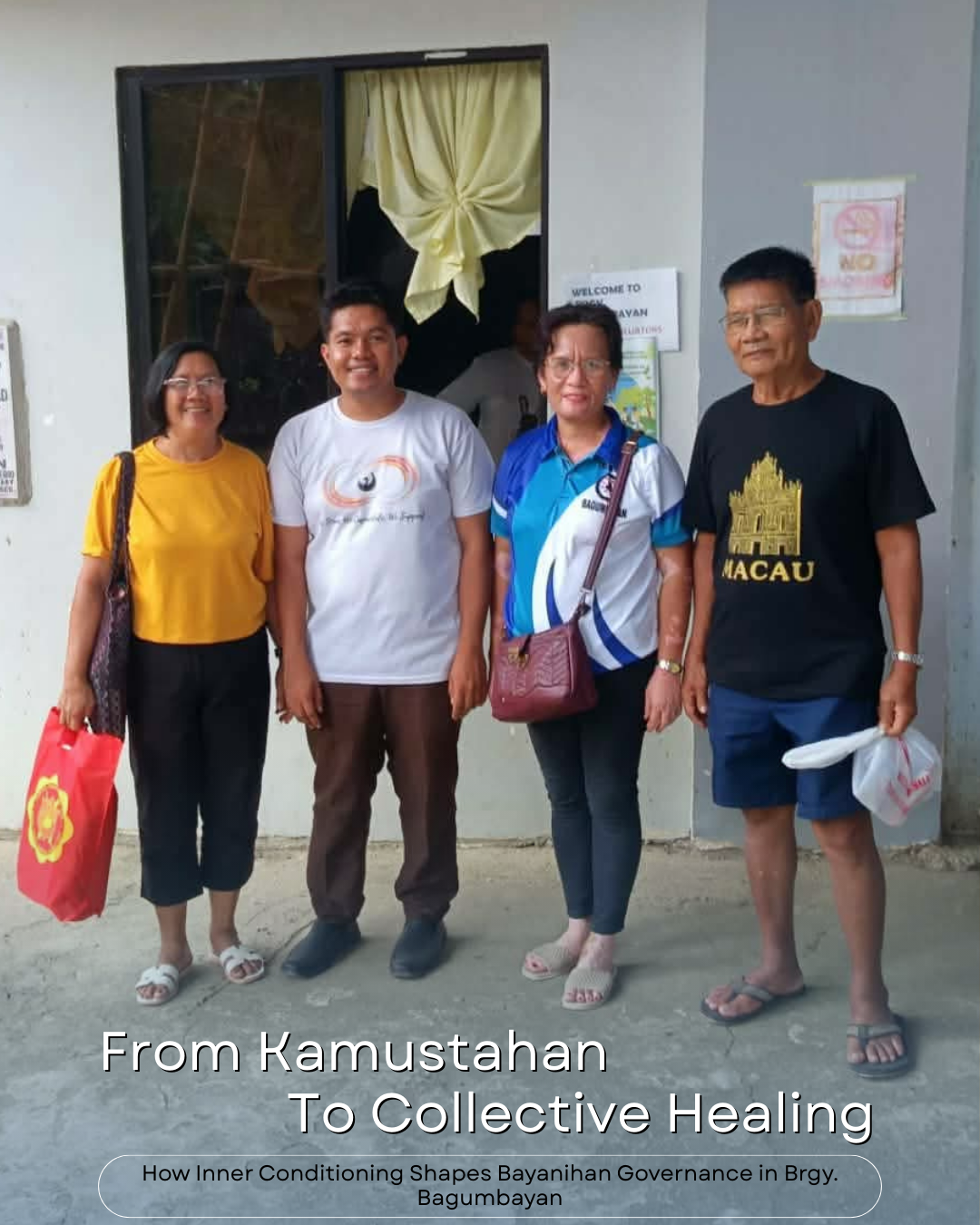
In Barangay Bagumbayan, Santa Barbara, governance recently took a quieter—but deeper—form. There were no long speeches, no podiums, and no rehearsed lines. Instead, there was kamustahan (a heartfelt check-in)—the kind that asks not just “How are you?” but “How are you, really?”
This was the heart of the Inner Conditioning Workshop (ICW) Weekly Kamustahan (Weekly Check-In), a safe space under the IPAT-SIAD / Bayanihan Governance Program of SEA Inc., where public servants are reminded that before leading others, one must first understand oneself.
As the saying goes, “Ang mabuting pamamahala ay nagsisimula sa mabuting pagkatao” (Good governance begins with good character). This belief quietly guided every story shared that day.
Choosing Peace as a Form of Strength
For Kagawad Marlene, the ICW journey that began last year continues to shape how she sees people—and herself.
“Hindi lahat ng tama sa akin ay tama rin sa mata ng iba” (Not everything I believe is right is also right in the eyes of others).
She shared how ICW helped her realize that people are often quick to judge, rarely knowing the full story behind someone’s actions. Instead of engaging in endless arguments, she has learned to adjust, step back, and choose peace.
This is not weakness—it is wisdom.
Tired of unnecessary confrontations, Kagawad Marlene now channels her energy toward what truly matters: her family. Her hopes are simple yet profound—her nurse-child passing the Manila examinations in preparation for working abroad, her youngest child’s graduation and pinning ceremony, and a household blessed with good health—where everyone eats well, avoids illness, and finds the strength to endure life’s challenges.
Her story reflects one of ICW’s core lessons: inner clarity leads to calmer leadership—a value central to IPAT-SIAD, where personal transformation strengthens participatory and inclusive governance.
Holding the Family Together, Even When It Hurts
Barangay Treasurer Rose spoke with honesty that resonated deeply with everyone present.
She expressed gratitude for her family and shared a small but meaningful victory: her husband slowly reducing his drinking. Yet her reflection did not shy away from pain. Just the day before, she cried—over family issues involving an elder relative, a New Year incident, and the heavy burden of being the one who takes responsibility while also being questioned and blamed.
Sometimes, the strongest person in the family is the one who cries in private but still shows up the next day.
Amid emotional strain—made heavier by stories overheard and anger passed around—Treasurer Rose continues to hope. She dreams of her child graduating, passing the board examination, and a family blessed with good health.
Her story reminds us that Bayanihan Governance is not only about collective action in public spaces—it is also about unseen acts of care within families, carried silently by people who still serve their communities despite personal struggles.
Becoming an Asset, Not a Liability
Sir Isek summed up the ICW experience with gratitude and purpose:
“In 2025, I am deeply grateful that my health significantly improved and that I became part of the ICW journey, which broadened my awareness and understanding of many aspects of my life.”
For him, ICW did more than heal—it awakened responsibility. The process inspired him to generate positive ideas that improve his organization and address wider civil society concerns. Looking ahead to 2026, his hope is clear: to serve people, society, and country—and to be an asset rather than a liability.
This mindset captures the essence of SEA Inc.’s IPAT-SIAD framework: empowered individuals strengthening institutions, communities, and governance systems from the inside out.
Why ICW Matters in Local Governance
The ICW Weekly Kamustahan (Weekly Check-In) may look simple, but its impact runs deep. By creating spaces for reflection, empathy, and shared humanity, it nurtures leaders who are emotionally grounded, self-aware, and compassionate.
And when leaders are grounded, policies become more humane, decisions more inclusive, and governance more participatory—the very goals of Bayanihan Governance.
In Brgy. Bagumbayan, governance did not begin with a resolution—it began with listening.
Because sometimes, the most impactful reform starts with a single, sincere question:
“Kamusta ka?” (How are you?)


Leave a Reply