
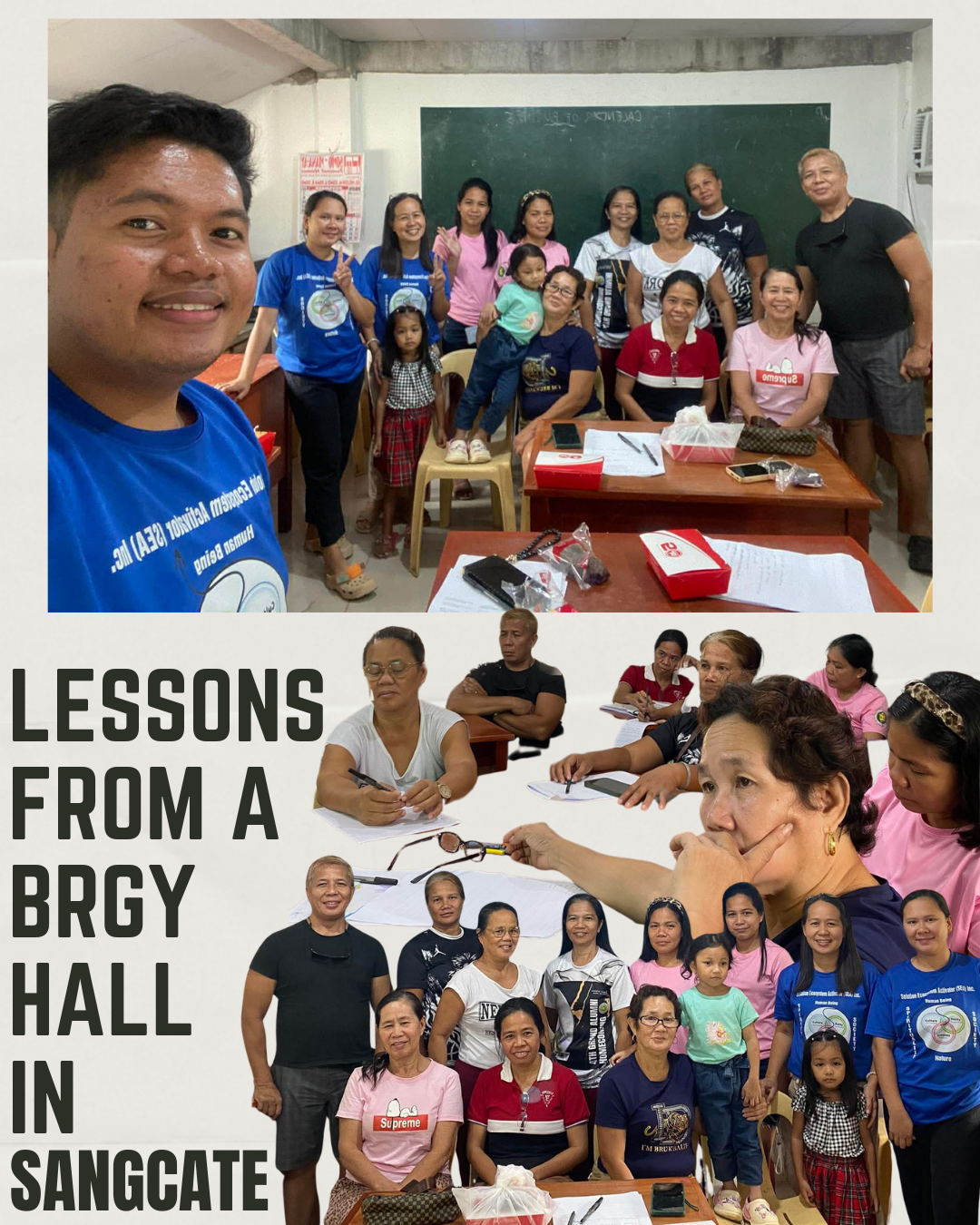
On a quiet January morning in Barangay Sangcate, Santa Barbara, Iloilo, governance stopped being an abstract word buried in legal textbooks and became something refreshingly human. Chairs were arranged, notebooks opened, and conversations flowed—not just between officials, but among civil society groups, community representatives, and SEA staff who all shared the same simple question: How do we make development real for the people who live here?
The Barangay Development Council (BDC) Orientation held on January 8, 2026, led by Ms. Rosanna Constantino, was not your usual lecture-heavy seminar. It felt more like a community reality check—grounded in law, yes, but alive with stories, reminders, and gentle nudges toward accountability and participation.
At the heart of the discussion was the Local Government Code of 1991 (RA 7160), a law born in the aftermath of People Power I, when the country collectively said that power should no longer sit comfortably at the top. “Decentralization,” Ms. Constantino reminded the group, “was never meant to be just administrative—it was meant to be democratic.” In other words, governance was designed to be closer to the people, not farther from them.
One of the most eye-opening moments came when she unpacked the roles and responsibilities of barangay officials—yes, including executive powers and honoraria—but quickly pivoted to something more important: service. She talked about devolved basic services, from agricultural support through the Municipal Agriculture Office to social services via the MSWDO. The message was clear: authority without service is just a title.
But the real soul of the orientation emerged when the conversation shifted to participation. “Development plans are not photocopy machines,” Ms. Constantino quipped, drawing laughter—and knowing nods—from the room. She addressed a common but often unspoken issue: barangay plans that look suspiciously similar to those of neighboring communities. The room grew quiet as the point landed. Planning, she stressed, must be participatory, realistic, and rooted in the actual lives of people—not cut-and-paste exercises designed to tick compliance boxes.
This is where SEA’s Bayanihan Governance framework found its strongest echo. Bayanihan, after all, is about collective effort. The BDC, with its mix of barangay officials and CSO representatives—40% of whom must be women—is a living structure of shared responsibility. It is governance by conversation, by inclusion, by listening. As one participant casually shared during a break, “Mas madali pala magsalita kapag alam mong may makikinig.” (It’s easier to speak when you know someone is listening.)
The orientation also clarified the BDC’s core tasks: crafting the three-year Barangay Development Plan and the Annual Investment Program. These aren’t just documents; they are promises on paper—promises that only mean something if communities help write them. Integrating sectoral plans, acknowledging local realities, and involving CSOs, POs, NGOs, and even the private sector turn these plans into tools for change rather than shelf decorations.
What happened in Sangcate may seem small in the grand scheme of national governance, but this is precisely how systems change—barangay by barangay, conversation by conversation. SEA’s presence, alongside local leaders and civil society, reinforced a simple but powerful idea: governance works best when it feels like a shared table, not a closed door.
Or, as Ms. Constantino aptly put it near the end of the session, “Ang kaunlaran, hindi iniimbento sa opisina—binubuo ito kasama ang komunidad.” Development is not invented in offices; it is built with communities.
In Barangay Sangcate, that building quietly began. And in the spirit of bayanihan governance, it reminded everyone present that democracy is strongest when everyone helps carry the load.


Leave a Reply