
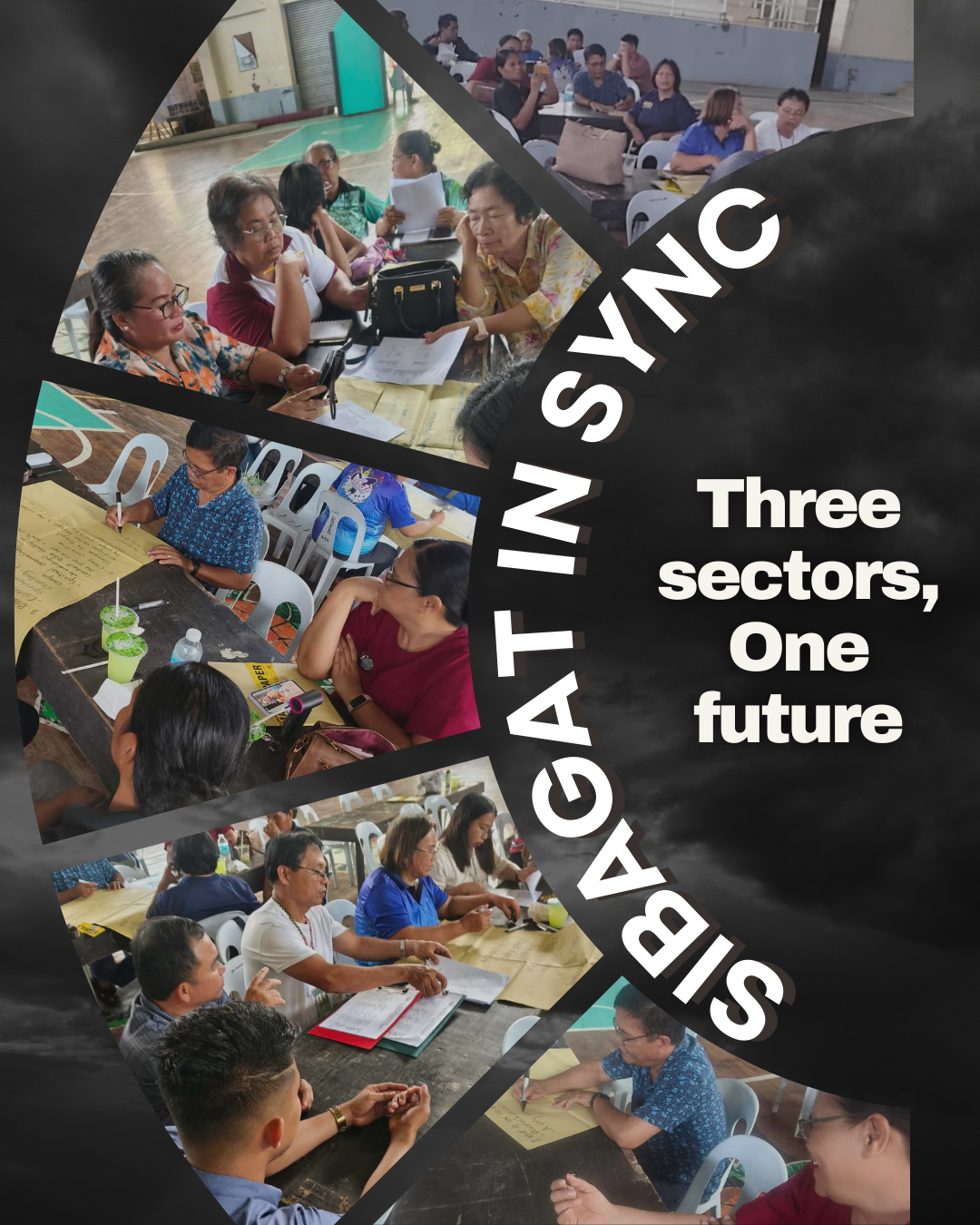
Under the wide, echoing ceiling of the Sibagat Municipal Gymnasium, something refreshingly uncommon happened: people did not gather to compete for attention—they gathered to share it.
In Sibagat, leaders from Civil Society Organizations, the business sector, and the Local Government sat side by side for the “Trifolding Synergy: Strategic Plan Validation and Alignment Workshop.” It may sound like a mouthful, but what unfolded was simple and powerful: three sectors choosing alignment over isolation.
And that choice changes everything.
More Than a Meeting—A Shared Compass
The workshop validated the Strategic Plan developed under the IPAT-SIAD framework. But validation here was not ceremonial. It was rigorous. Participants examined feasibility, questioned assumptions, refined directions, and ensured that the plan did not merely look good on paper—but felt right on the ground.
What emerged was a unified Mission:
To work in synergy to promote sustainable economic growth, strengthen human and social development, and advance transparent, inclusive governance.
The Vision stretches toward 2028—imagining a progressive and resilient Sibagat where empowered citizens, responsible entrepreneurs, and accountable leaders move in harmony. Not in parallel lanes. Not in polite distance. But in deliberate partnership.
That distinction matters.
Seven Areas, One Direction
Across seven Key Result Areas, stakeholders did something rare: they agreed.
Economic priorities aim to expand livelihoods, nurture enterprises, and strengthen capacity through training, microfinance education, and leadership programs. Trade fairs and business summits will not just display products—they will display confidence in local enterprise.
Political reform moves toward participatory governance, highlighted by the planned establishment of the People’s Council of Sibagat by 2027. That is not merely structural innovation; it is a statement that governance belongs to the governed.
Human development initiatives elevate digital literacy, financial management, mental health awareness, and mobile health caravans. Solar streetlights and CCTV installations in remote and Indigenous barangays are practical symbols of inclusion—because development that leaves some areas dark is not development at all.
Social initiatives promise broader assemblies and stronger information drives across upland and lowland communities. Cultural programs—People’s Summits, exhibits, and festivals—ensure that progress does not erase heritage but celebrates it.
Spiritual fellowships reinforce shared values. Ecological programs promote organic agriculture, composting expansion, and environmental stewardship. Because resilience is not built in conference halls alone—it is planted, cultivated, and protected.
From Vision to Legislative Commitment
Perhaps the most decisive moment is still to come: the Strategic Plan’s endorsement by the Sibagat Sanggunian.
That endorsement marks a critical shift—from aspiration to institutional commitment.
Once adopted, the plan will not merely inspire speeches. It will guide policies, budgets, and partnerships from 2027 to 2028. It becomes a framework for accountability. A benchmark for progress. A reminder that promises were made in full view of one another.
Why Trifolding Works
The trifolding approach is elegantly practical.
Civil society brings community pulse and lived realities..
The business sector fuels innovation and economic momentum.
Government anchors structure, policy, and continuity.
Individually, each sector moves. Together, they accelerate.
Too often, development efforts resemble solo performances. In Sibagat, this workshop felt more like an orchestra rehearsal—different instruments tuning to the same key.
The Real Work Begins Now
Plans do not transform municipalities. People do.
The validated Strategic Plan now stands ready—not just as a shared vision, but as a proposed legislative commitment. Its impact will be measured not by the thickness of its document, but by the steadiness of its implementation.
If sustained, this trifolding synergy could become Sibagat’s defining strength: a community that refuses to let sectors drift apart, and instead chooses convergence.
Because when civil society listens, business invests, and government commits—progress stops being a promise.
It becomes a pathway.
And in Sibagat, that pathway is no longer theoretical. It is being paved—together.


Leave a Reply