
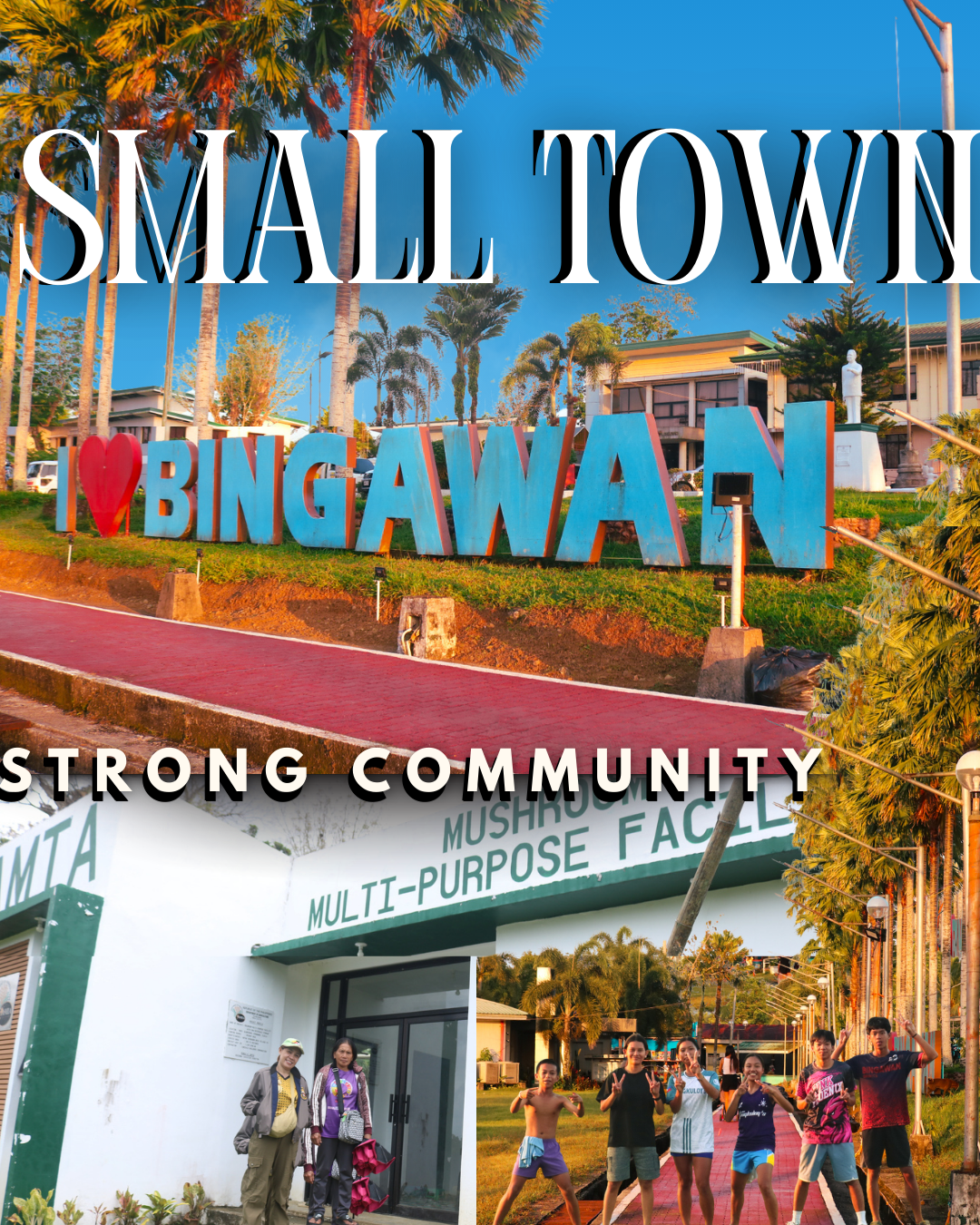
There’s a certain bias we carry—quiet but persistent—that big impact must come from big places. That innovation belongs to cities, that progress needs scale, and that rural towns are always “catching up.” Spend three days in Bingawan, however, and that assumption begins to unravel—politely at first, then completely.
Because in Bingawan, what you see is not a town trying to keep up. It’s a community that already knows exactly who it is.
The recent three-day immersion led by SEA Sibagat Coordinator Ms. Avha Hilario, alongside Municipal Coordinator Mr. Carlo Menas—who now marks a full year of service in the municipality—offered more than observation. It revealed something far more compelling: a living, breathing example of grassroots governance that works not because it is perfect, but because it is shared.
From the moment Ms. Hilario arrived, the tone was set—not by formal programs or structured agendas, but by people. Some recognized her, many did not, yet the استقبال was the same: warm, open, and disarmingly genuine. In Bingawan, hospitality is not a performance; it’s a default setting. Conversations don’t need icebreakers—they simply begin.
And that matters. Because real participation doesn’t start in conference rooms; it starts in trust.
As the immersion unfolded across barangays, what became evident was a quiet but consistent commitment to transparency. No grand declarations, no oversized banners—just Full Disclosure Boards posted where they should be: in plain sight. Budgets, projects, expenditures—laid out not as compliance, but as a conversation with the public.
It’s easy to underestimate something as simple as a transparency board. But in practice, it is a statement: “This is your government. You have the right to see it.” In many places, that idea still struggles to take root. In Bingawan, it’s already part of the landscape.
The same grounded practicality extends to community infrastructure. Daycare centers that are not just built, but cared for. Parks that may be small, but are alive with use. Covered gymnasiums that double as spaces for decision-making and celebration. Solar dryers quietly doing the important work of protecting farmers’ harvests. Basketball courts echoing with energy. And yes, even mushroom production facilities—humble in appearance, but rich in potential.
None of these are extraordinary on their own. But together, they tell a story: development that is not flashy, but functional; not aspirational, but accessible.
Equally striking is the role of civil society. In Bingawan, organizations are not on the sidelines waiting to be consulted—they are in the thick of things. Mobilizing, organizing, supporting, and sometimes gently pushing. The relationship between the local government and civil society is not adversarial, nor is it performative. It is collaborative in the most practical sense of the word: working together because it gets things done.
And then there’s the quiet strength of the health sector. A conversation with a Barangay Health Worker revealed something that statistics often fail to capture: progress that feels personal. Low mortality rates. A noticeable decline in teenage pregnancies. Minimal cases of malnutrition. Families of children with autism not left to navigate alone, but supported with care and guidance.
These are not abstract indicators. These are lived improvements—evidence that when systems work at the grassroots level, they change real lives.
But perhaps the most telling moment of the immersion didn’t happen in a barangay hall or during a site visit. It happened in the evening, in the poblacion, where music played and the community gathered—not for a meeting, but for Zumba.
There is something profoundly revealing about a town that shows up consistently for something as simple as a group exercise session. Led by the local women’s group, the activity is equal parts fitness and fellowship. Ms. Hilario joined in, not as a coordinator observing from the sidelines, but as part of the rhythm of the community.
Because in Bingawan, participation doesn’t clock out at the end of the workday. It spills into everyday life.
And maybe that’s the real lesson here
Participatory governance is often framed in technical terms—frameworks, mechanisms, processes. But in Bingawan, it looks much simpler and much more powerful. It looks like people showing up. It looks like leaders being visible. It looks like information being shared. It looks like communities moving—sometimes literally—in sync.
The three-day immersion did not uncover a perfect system. No such place exists. But it did reveal something far more valuable: a community that understands that development is not delivered—it is built, together, day by day, decision by decision.
So yes, Bingawan is a small town.
But if strength is measured by trust, participation, and shared ownership, then it stands taller than most.


Leave a Reply