
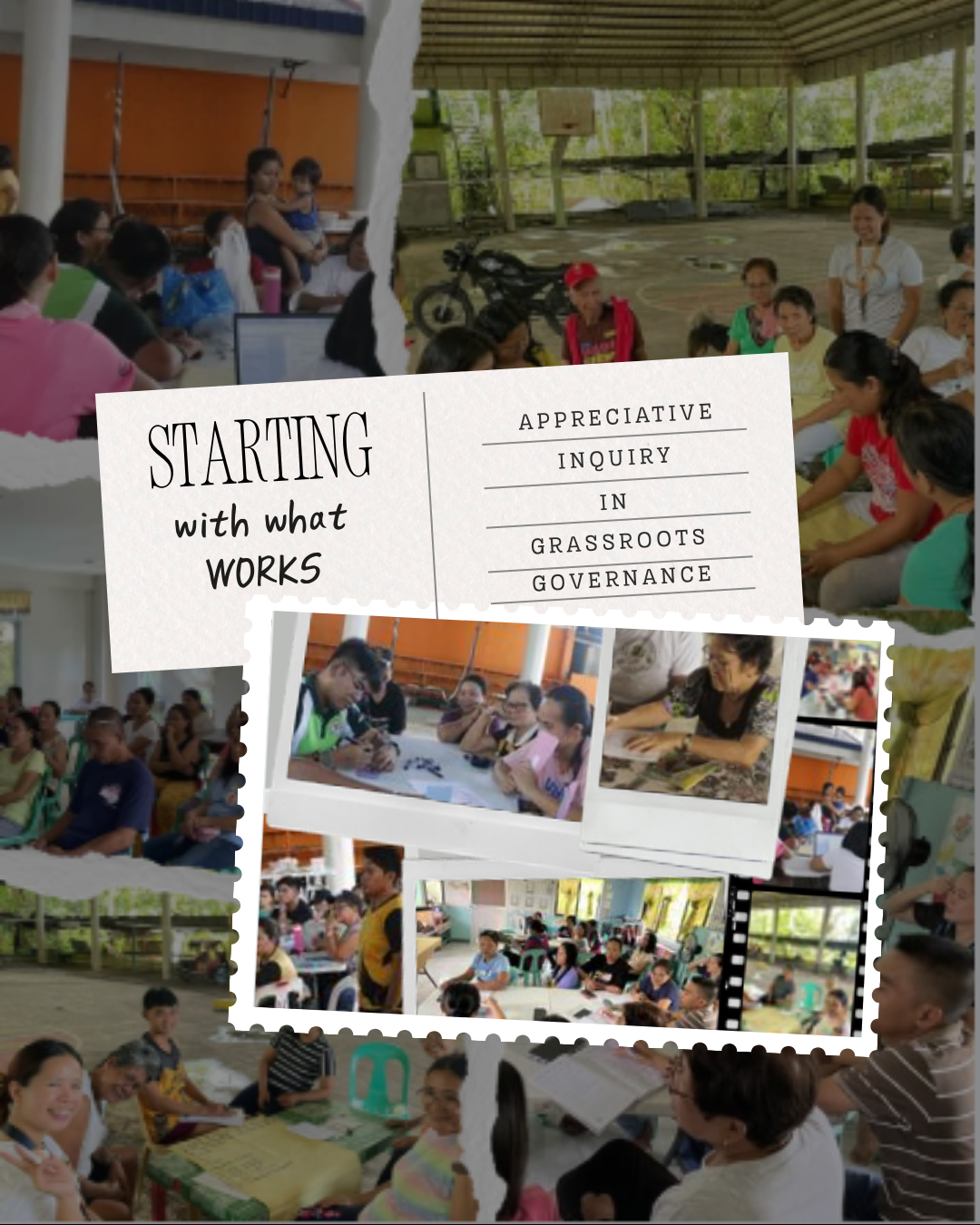
In many planning meetings, the first question often sounds like a complaint: “What is the problem?”
But in the strategic planning orientations and capacity-building sessions of Solution Ecosystems Activator (SEA) Inc., the first question is refreshingly different:
“What is already working in our community—and how can we build more of it?”
This is the heart of Appreciative Inquiry (AI), one of the key tools used in the Bayanihan Governance Program to empower grassroots leaders, civil society organizations, and local government partners. Instead of dwelling on deficits, AI shines a light on strengths, stories, and possibilities.
As management thinker Peter Drucker once said, “The best way to predict the future is to create it.” Appreciative Inquiry simply adds: create it by building on what is already good.
From Problems to Possibilities
In SEA Inc.’s orientations, community members are invited to share stories—moments when their barangay, organization, or municipality worked at its best. A farmer talks about how neighbors helped rebuild after a storm. A women’s group recalls how collective savings lifted families out of debt. A youth leader shares how volunteerism revived a once-neglected community space.
These stories are not just anecdotes. They become the foundation of strategic planning.
Instead of asking “Why are we failing?” the conversation shifts to “How can we multiply these successes?”
It echoes the words of Margaret Mead:
“Never doubt that a small group of thoughtful, committed citizens can change the world; indeed, it’s the only thing that ever has.”
The AI Process: Discover, Dream, Design, Deliver
SEA Inc. guides participants through the classic 4D cycle of Appreciative Inquiry:
- Discover – identifying the strengths and successes of the community
- Dream – imagining what the community could become if these strengths grow
- Design – crafting strategies and collaborative plans
- Deliver (or Destiny) – committing to concrete actions and shared responsibility
The process transforms planning sessions into spaces of hope and collective imagination rather than complaint forums.
Bayanihan as a Planning Method
For grassroots leaders, AI resonates deeply with the Filipino spirit of Bayanihan—the tradition of collective action where neighbors literally carry a house together.
Strategic planning becomes less about documents and more about shared ownership of the future. CSOs, local officials, women leaders, farmers, and youth begin to see themselves not just as beneficiaries of development but as co-creators of it.
As Helen Keller wisely said,
“Alone we can do so little; together we can do so much.”
Planning with Hope
What SEA Inc. demonstrates through Appreciative Inquiry is simple yet powerful: communities grow in the direction of the questions they ask.
When the questions focus on failure, people feel stuck.
When the questions highlight strengths, people begin to move.
And in the halls of municipal orientations and barangay workshops, that movement becomes visible—ideas flowing, partnerships forming, and leaders realizing that the seeds of sustainable governance are already within their communities.
Because sometimes the most powerful planning tool is not a spreadsheet or policy document.
Sometimes, it is simply the courage to ask:
“What is the best of who we already are—and how can we grow from there?”


Leave a Reply