There are meetings that fill calendars, and there are meetings that quietly rearrange the future.
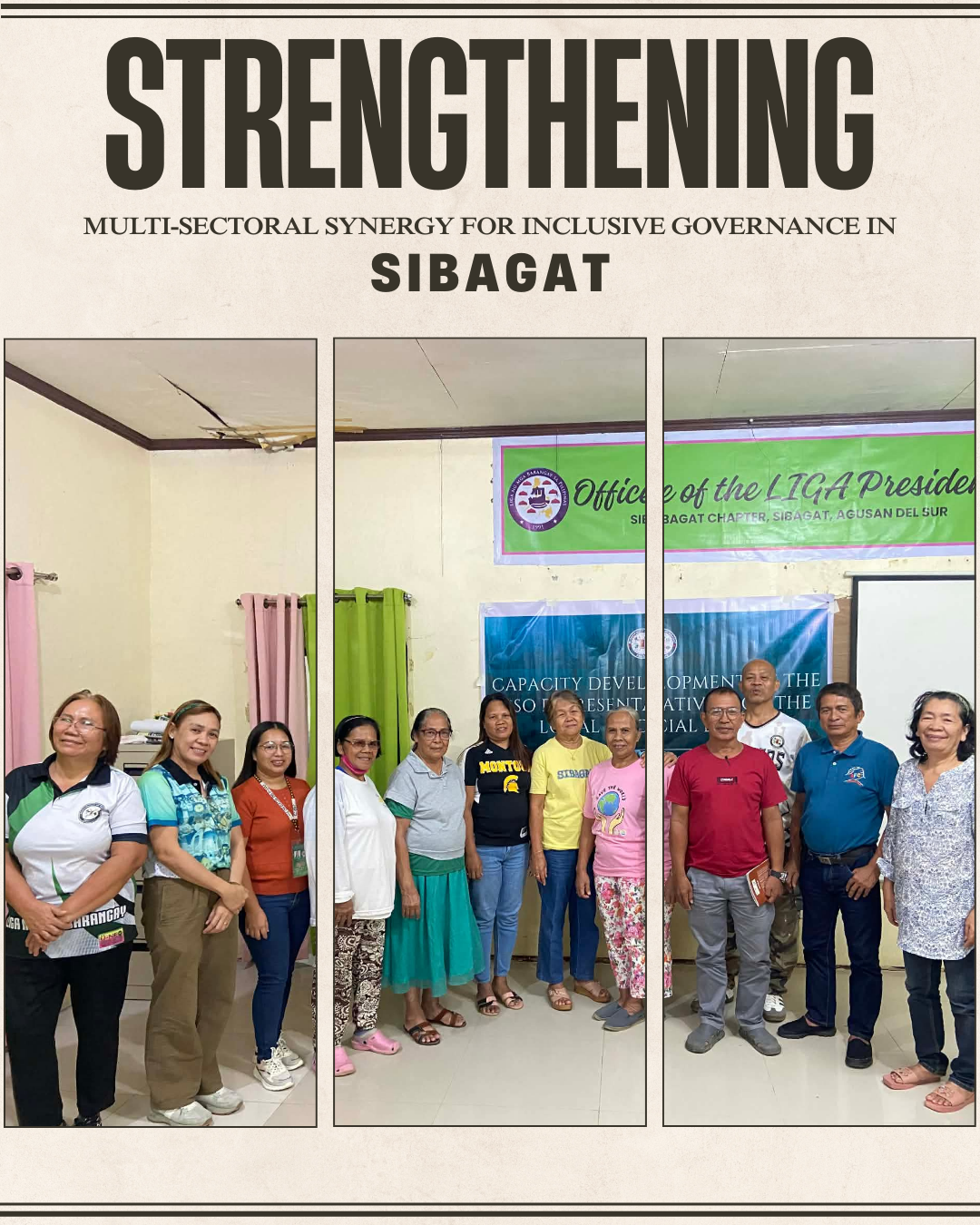
Last week in the Municipality of Sibagat, it was the latter.
The Collective IPAT-SIAD Team convened a coordination and planning meeting that did not merely gather names around a table—it gathered sectors around a shared responsibility. Civil Society Organizations (CSOs), the business community, and local government offices sat not as separate blocs, but as co-authors of the municipality’s next chapter.
As SEA Mindanao Coordinator Ms. Avha Hilario aptly remarked during the session, “Governance becomes transformative when sectors stop working beside each other and start working with each other.”
That shift—from coexistence to collaboration—was the real agenda of the day.
When Three Sectors Speak One Language
Under the Integrated Participatory Accountability and Transparency towards Sustainable Integrated Area Development (IPAT-SIAD) known as Bayanihan Governance framework, the meeting focused on aligning priority multi-sectoral initiatives in preparation for upcoming project activities.
It was not a ceremonial discussion. It was surgical.
Participants revisited:
- The CSO, Business, and Government Sector Strategic Planning Validation
- The upcoming Kapehan Session with government officials and heads of offices
- Scheduled project engagements
- Emerging governance concerns
One participant from the business sector humorously noted, “It’s easier to align budgets than to align perspectives—but today, we did both.”
Behind the laughter was a truth: development falters not from lack of plans, but from lack of alignment.
The session became a living example of what inclusive governance looks like—not grand speeches, but deliberate listening; not competition, but convergence.
The Trifolding Moment: February 24–25, 2026
One of the most significant outcomes was the consensus to conduct a Joint Trifolding Strategic Planning Validation and Alignment on February 24–25, 2026 at the Sibagat Gymnasium, expected to gather around 50 participants.
This two-day activity is more than a workshop—it is a calibration exercise for governance itself.
Why trifolding? Because governance in Sibagat recognizes three pillars:
- Civil Society
- Business
- Government
When these three fold into one strategic direction, development stops being fragmented and starts being sustainable.
As one CSO representative reflected, “We have plans in our folders. Now we are putting them on the same table.”
And that table, metaphorically, is where inclusive governance begins.
Kapehan: Brewing Transparency
Tentatively set for March 4, 2026, the Kapehan Session with Government Officials and Heads of Offices aims to deepen open dialogue and constructive partnerships.
There is something uniquely powerful about conversations over coffee. Hierarchies soften. Ideas flow more freely. Questions are asked with less fear and more clarity.
If governance is to be transparent, it must first be conversational.
The Kapehan is not about caffeine. It is about candor.
The People’s Council Conversation: Readiness Before Structure
Perhaps the most thoughtful discussion centered on the proposed establishment of a People’s Council in Sibagat.
Rather than rushing to formalize the structure, stakeholders emphasized the need for readiness—shared understanding, clarified purpose, and unified direction.
It was a refreshing approach.
Too often, institutions are created before intentions are aligned. In Sibagat, the sectors chose alignment first.
As one government representative put it, “Structures can be built quickly. Trust cannot.”
And so the conversation focused not only on what a People’s Council would look like, but what it must stand for.
The Quiet Power of Preparedness
This coordination meeting may not make headlines. It may not trend online. But its significance lies in its quiet precision.
It marked a preparatory milestone—an intentional pause before action.
By strengthening collaboration, updating one another on project developments, and openly discussing prevailing issues, the Collective IPAT-SIAD Team demonstrated that inclusive governance is not accidental. It is designed.
And design requires dialogue.
Governance as Shared Stewardship
In the end, what unfolded in Sibagat was not just a meeting. It was a reminder.
Inclusive governance is not the responsibility of one office, one organization, or one sector. It is a shared stewardship.
When CSOs bring community voice, businesses bring innovation and resources, and government brings mandate and structure, the municipality does not merely function—it evolves.
Sibagat’s journey under the IPAT-SIAD framework shows that synergy is not a buzzword. It is a discipline.
And as the February validation approaches, one thing becomes clear:
The future of Sibagat is not being drafted by a single hand.
It is being written—deliberately—by many.


Leave a Reply