
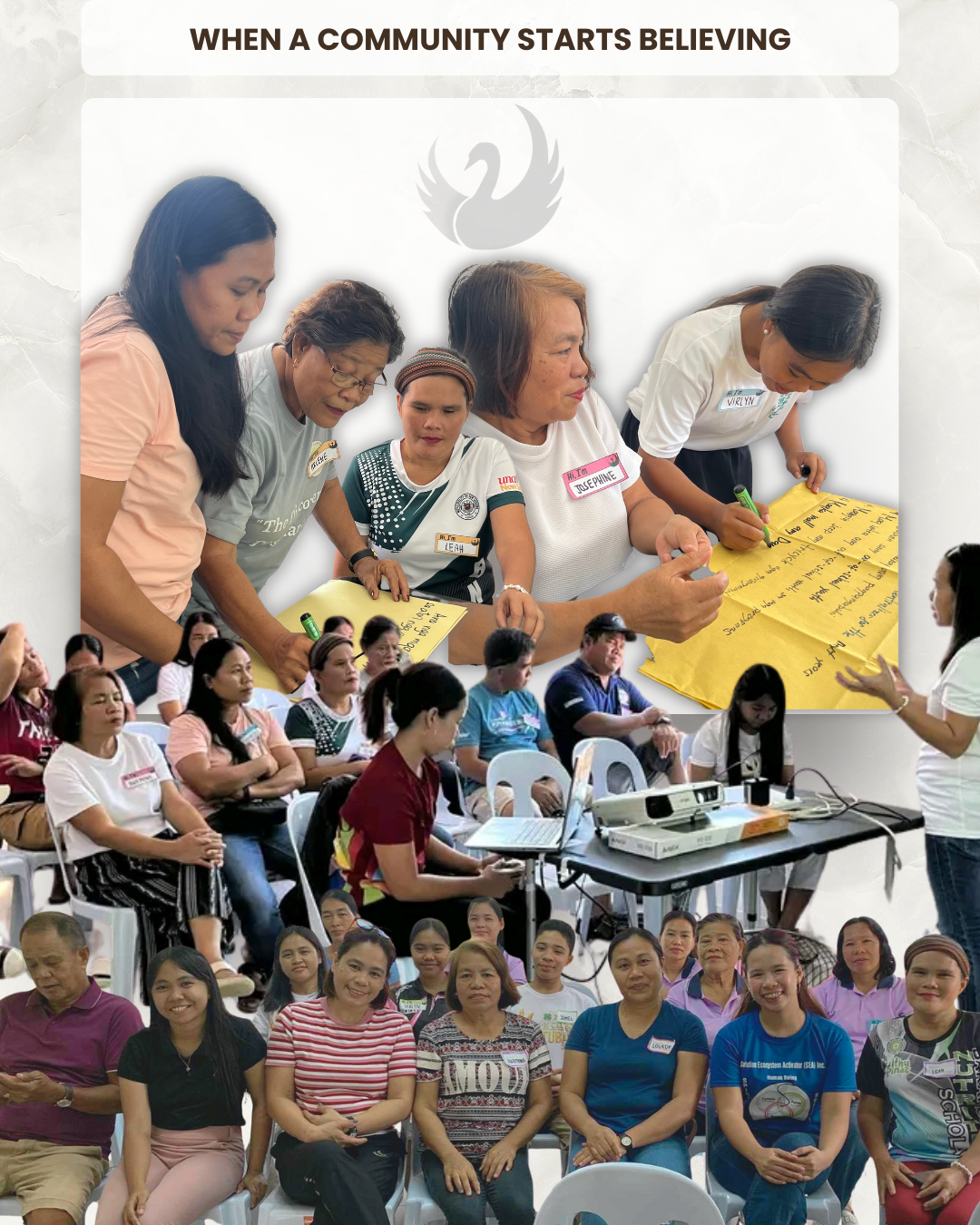
On October 29 and 30, 2025, the Barangay Hall of Brgy. Dawis New Lucena became more than just a venue—it became a space where people rediscovered their strengths, voiced their hopes, and realized that community progress begins when everyone chooses to see what is good and build from there. This was the spirit of the two-day Appreciative Inquiry (AI) Workshop facilitated for Barangay Dawis.
Day 1 began with a prayer led by volunteer Trixie Compuesto, grounding everyone in humility and shared intention.
Afterward, Ma’am Os introduced Appreciative Inquiry, explaining that it is not about listing what is wrong but uncovering the strengths that make a community thrive. The participants, composed of barangay officials, health workers, tanods, farmers, and 4Ps members, immediately leaned into the process.
As the Discovery Stage unfolded, the room buzzed with stories. People shared why they loved living in their barangay: the matawhay or peaceful lifestyle, the kind neighbors, the sense of belonging that comes from family roots planted over generations. Someone mentioned the clean and reliable water supply; another talked about the unique footpaths across farmlands that visitors always found charming. Others appreciated the accessible transportation, the dependable peace and order, the approachable barangay officials, and the contagious energy of the youth who were always ready to help. What stood out most was the constant presence of bayanihan—the tradition of community volunteerism—alive in every corner of Dawis.
When asked about moments when the community felt most alive, the stories became even more heartwarming. People remembered how barangay officials would immediately visit households during calamities, checking if everyone was safe.
They recalled carrying water, bamboo, or firewood for neighbors in need. Many shared vivid memories from the pandemic years—when food packs, disinfectants, vitamins, masks, and face shields were shared generously among households. There were stories of parents, officials, and volunteers working hand-in-hand at the opening of classes, preparing learning materials, and ensuring every child could keep going.
They remembered the joy of clean-up drives done with all sectors involved, the excitement of fiesta activities like fun runs and live bands, and the spiritual connectedness when the whole barangay gathered for mass. Each memory painted a picture of a community that may not always be perfect but is consistently present for one another.
The Dream Stage invited everyone to imagine what a better Dawis could look like. Angela asked them to dream boldly, leading to visions of a more peaceful and progressive barangay where out-of-school youth return to education and find purpose, where markets and livelihood opportunities flourish, and where the community deepens its spiritual life. People hoped for scholarships for all students, separate clinic facilities, more livelihood opportunities, a completed farm-to-market road, and even a mall someday. Their dreams were big, hopeful, and genuine.
Yet even as they imagined change, participants were clear about what they wanted to preserve. They spoke passionately about keeping their mabinuligon or helpful nature, maintaining unity and respect, strengthening their God-centered way of life, sustaining cleanliness, and upholding transparency in governance. These values, they believed, were the foundation that should not be shaken by progress.
Through lively discussions, debates, and laughter, the group crafted a Vision Statement that reflected the heart of Barangay Dawis. Their English translation described a community committed to harmony, peace, respect, environmental care, transparency in governance, a drug-free environment, good health, economic progress, and continuous learning. This vision then gave birth to their Mission Statement—an outline of how they intended to achieve these aspirations through leadership, education, environmental care, peacekeeping, livelihood support, cultural traditions, and strong community engagement.
Day 2 shifted the atmosphere from imagining to planning. Angela introduced Photovoice, a creative tool that required participants to take photos of issues within their community. When they returned with their images—some showing waste problems, others revealing infrastructure concerns—they were suddenly able to articulate the urgency behind each problem.
One participant said, “When I took the photo, that’s when I finally saw the problem clearly.” These photos created a shared awareness that words alone could not capture.
Strategic Planning followed, guiding participants to write goals and action plans across seven key dimensions: Economic, Cultural, Human, Political, Societal, Ecological, and Spiritual. Discussions became animated as people proposed livelihood trainings, TESDA programs, community markets, cultural celebrations, youth development activities, disaster drills, feeding programs, scholarship initiatives, environmental protection efforts, and strengthened spiritual programs. Each idea reflected a simple truth: Dawis is ready to grow, and its people are ready to take ownership of that growth.
As the workshop drew to a close, the participants shared their reflections. Virlyn spoke about realizing the importance of youth voices and how planning, though challenging, becomes possible when the community works together. Jomel shared how he gained confidence interacting with adults. Leah, despite personal stress, felt grateful that the workshop created space for honest conversations and revealed issues she had never noticed before through Photovoice. Kagawad Lourdes expressed pride that Dawis now had its own Vision and Mission, while Kagawad Bonifacio emotionally shared that he had attended many seminars before, but this one felt different—awakening both him and the community.
In just two days, the people of Dawis discovered something powerful: their future is not something they wait for—it is something they create. Appreciative Inquiry did not simply give them tools; it reminded them of their strengths, encouraged them to dream together, and empowered them to act with unity.
And perhaps the workshop leaves us with one essential question:
If a community truly believes in its own potential, what extraordinary future can it build—together?


Leave a Reply