
If you think barangay governance is all paperwork and sleepy meetings, Barangay Duyan-Duyan in Sta. Barbara, Iloilo would like to politely—but firmly—disagree.
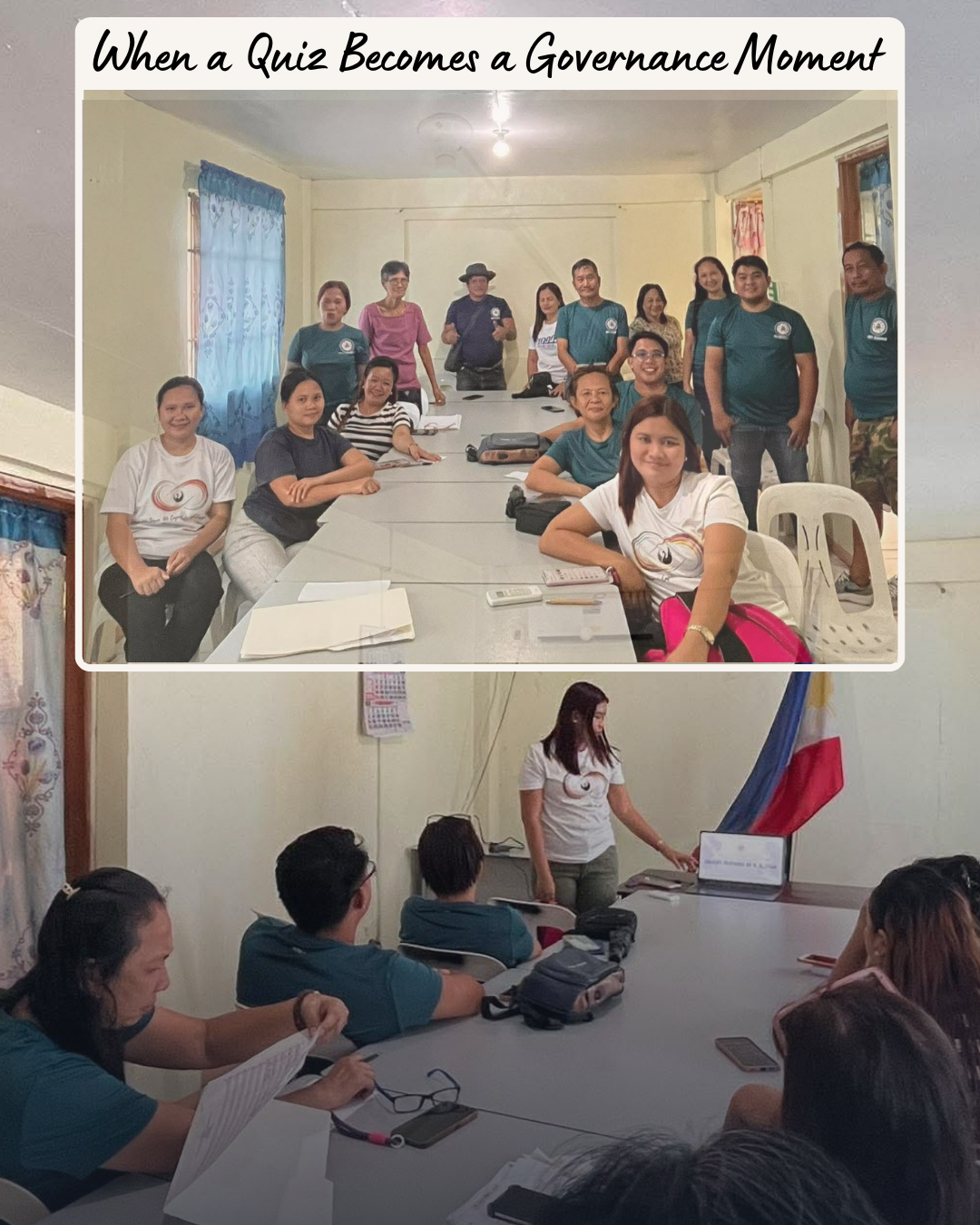
On January 7, the Barangay Development Council (BDC) Orientation held at the barangay hall proved that local governance can be both serious and surprisingly lively. Sixteen participants—barangay officials, CSO representatives, and SEA staff—gathered not just to listen, but to actually understand what the BDC is supposed to do and why it matters.
The day opened in the most Filipino way possible: a prayer led by Mr. Atchmen Sotto Jr., followed by warm welcome remarks from Barangay Captain Carlo Cabigayan. It set the tone—grounded, respectful, and community-centered. From there, facilitator Ms. Mary Angelic Muzones took the group on a guided tour of local governance, starting from the big picture and working all the way down to the barangay level.
She began with the constitutional backbone of local autonomy, citing Section 23, Article II of the 1987 Philippine Constitution. It was a reminder that barangay governance is not a favor handed down from above—it is a right enshrined in law. From there, the discussion flowed into the Local Government Code of 1991 (RA 7160), unpacking how Local Special Bodies work and why Development Councils exist at every level of government.
At one point, a participant jokingly whispered, “Akala ko meeting lang ulit ito.” (I thought this was just another meeting.) A few minutes later, the same participant was actively asking questions about CSO accreditation and representation. That shift—from passive attendance to active engagement—is exactly what SEA’s Bayanihan Governance is all about.
The orientation also tackled DILG Memorandum Circular No. 2022-083, which governs the accreditation of CSOs and their selection to Local Special Bodies. Far from being a dry policy discussion, it sparked conversations about fairness, representation, and accountability. Who gets a seat at the table? Who speaks for whom? And how do barangay officials and CSOs work together without stepping on each other’s roles?
Ms. Muzones emphasized that the BDC is not a one-man—or one-office—show. Barangay officials have clear responsibilities, but so do CSOs. Governance, in this sense, becomes a shared practice, not a solo performance. One participant summed it up neatly: “Mas malinaw ngayon na hindi kami taga-approve lang, kundi taga-hubog din ng plano.” (It’s clearer now that we don’t just approve plans—we help shape them.)
And then came the plot twist.
To wrap things up, Ms. Muzones surprised everyone with a short quiz. Laughter filled the room, pens scratched paper a little faster, and suddenly the barangay hall felt more like a classroom with stakes. When Barangay Captain Carlo Cabigayan earned a perfect score, the room erupted in applause—proof that learning sticks better when it’s engaging.
Beyond the fun ending, the orientation carried a deeper relevance to SEA Bayanihan Governance. It showed that empowering communities starts with understanding the rules of the game—and then choosing to play it together. By grounding barangay leaders and CSOs in law, roles, and shared responsibility, the session strengthened the foundation for participatory planning and inclusive development.
In Duyan-Duyan, governance didn’t feel distant or intimidating. It felt human, collaborative, and even a little competitive—in a good way. And if a simple quiz can spark that level of energy, imagine what a well-functioning BDC can do for a community.
That’s bayanihan governance in action: learning together, laughing together, and building better plans—one barangay at a time.


Leave a Reply