
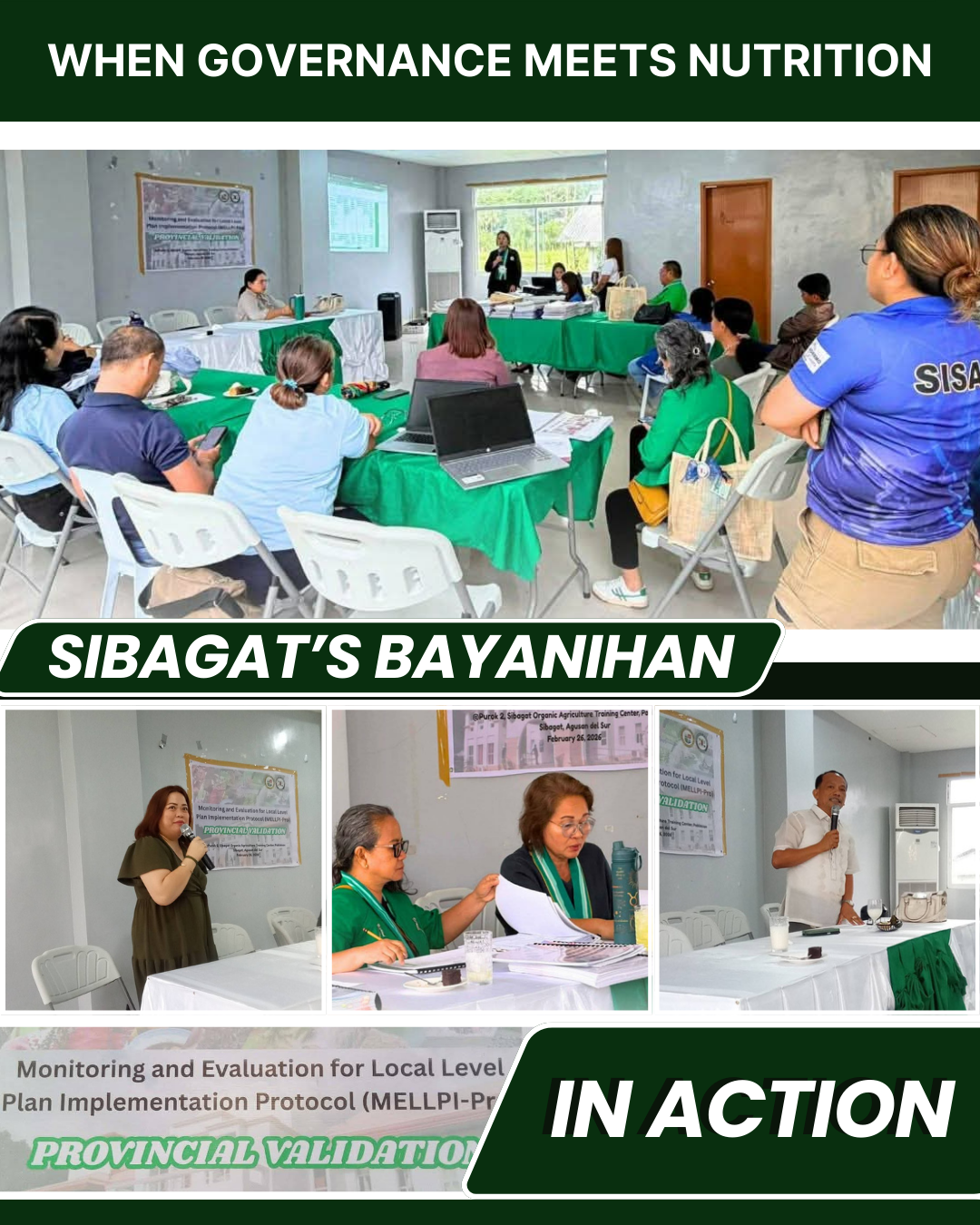
On an ordinary day at the Sibagat Organic Agriculture Training Center, something quietly extraordinary unfolded. Representatives from Civil Society Organizations (CSOs), members of the Local Health Board, the Municipal Nutrition Council, and local government officials gathered not just for compliance, but for commitment. The occasion was the Monitoring and Evaluation for Local Level Plan Implementation Protocol (MELLPI-Pro) Provincial Evaluation—a process that might sound technical on paper but, in Sibagat, felt more like a community reunion with a shared purpose: building a healthier future.
Anyone who has attended evaluation meetings knows they can sometimes feel like an exam you forgot to study for. But in Sibagat, the atmosphere told a different story. There was less anxiety and more pride. After all, the numbers, reports, and presentations reflected real efforts from real people who care deeply about the wellbeing of their community.
As one local health worker casually remarked during the session, “Nutrition work is not only about weighing children—it is about weighing our commitment as a community.” That simple statement captured the spirit of the day.
When Many Hands Feed One Mission
The evaluation, conducted by the Provincial Nutrition Evaluation Team (PNET), assessed the municipality’s nutrition programs in terms of efficiency, effectiveness, and impact. But beyond the technical indicators, what stood out most was the visible multi-sectoral collaboration.
Civil society representatives sat alongside municipal staff. Health officers exchanged insights with community leaders. Barangay advocates shared stories from the ground. It was governance in its most practical form—less about hierarchy and more about partnership.
In fact, one CSO representative joked, “If nutrition were a cooking pot, Sibagat has made sure everyone brings an ingredient.”
And truly, that’s what good governance looks like. No single office can solve malnutrition alone. It takes teachers encouraging healthy meals in schools, barangay leaders mobilizing families, health workers monitoring child growth, and community organizations sustaining advocacy campaigns.
The Power of Organized Commitment
Sibagat presented several noteworthy accomplishments during the evaluation. These included strengthened coordination among local nutrition implementers, improved monitoring and reporting systems, and more active barangay-level interventions. The municipality also highlighted its sustained Healthy Sibagat campaign, which promotes better nutrition and healthier lifestyles for children and families.
These achievements might sound procedural, but they carry real-life meaning. Better monitoring means children who might otherwise fall through the cracks are identified earlier. Stronger coordination ensures programs do not overlap or disappear halfway through the year. And consistent advocacy means parents are reminded—again and again—that nutrition begins at home.
A barangay nutrition scholar shared a small but telling anecdote: “Before, some parents thought weighing their children was just another government activity. Now they ask us when the next schedule will be.”
That shift—from indifference to ownership—is often the true measure of success.
Bayanihan Governance in Practice
What happened in Sibagat is a living example of the SEA Bayanihan Governance approach. At its core, Bayanihan Governance believes that sustainable development happens when government, civil society, and communities share responsibility and leadership.
Programs become stronger when they are not carried by institutions alone but supported by citizens who see themselves as partners in change.
In Sibagat’s case, the participation of CSOs during the MELLPI-Pro evaluation showed exactly that. Their presence signaled that nutrition is not just a government program but a community movement.
One municipal official summarized it perfectly:
“Evaluation is not just about checking if we did our job. It is about proving that we did it together.”
Beyond Evaluation, Toward Transformation
Evaluations are often seen as endings—the final chapter of a project cycle. But in Sibagat, the MELLPI-Pro Provincial Evaluation felt more like a checkpoint on a continuing journey.
The municipality’s commitment to data-driven planning, organized documentation, and continuous improvement shows that the work does not stop after presentations are done and reports are submitted. Instead, the insights gathered become guideposts for the next phase of action.
And perhaps that is the most encouraging takeaway: Sibagat is not simply aiming to pass evaluations. It is striving to build a healthier, more resilient, and nutrition-secure community.
The Quiet Strength of Collective Action
In a time when governance conversations can sometimes feel distant from everyday life, Sibagat offers a refreshing reminder: progress often grows from small but steady acts of cooperation.
When a barangay nutrition worker patiently records growth data, when a CSO supports community awareness campaigns, when local leaders invest in stronger health systems—these are the building blocks of change.
The spirit of bayanihan is often imagined as neighbors lifting a house together. But sometimes, bayanihan looks like something simpler: a room full of people studying reports, sharing ideas, and deciding that the health of their children is a responsibility they all carry.
And in Sibagat, that spirit is very much alive.


Leave a Reply