
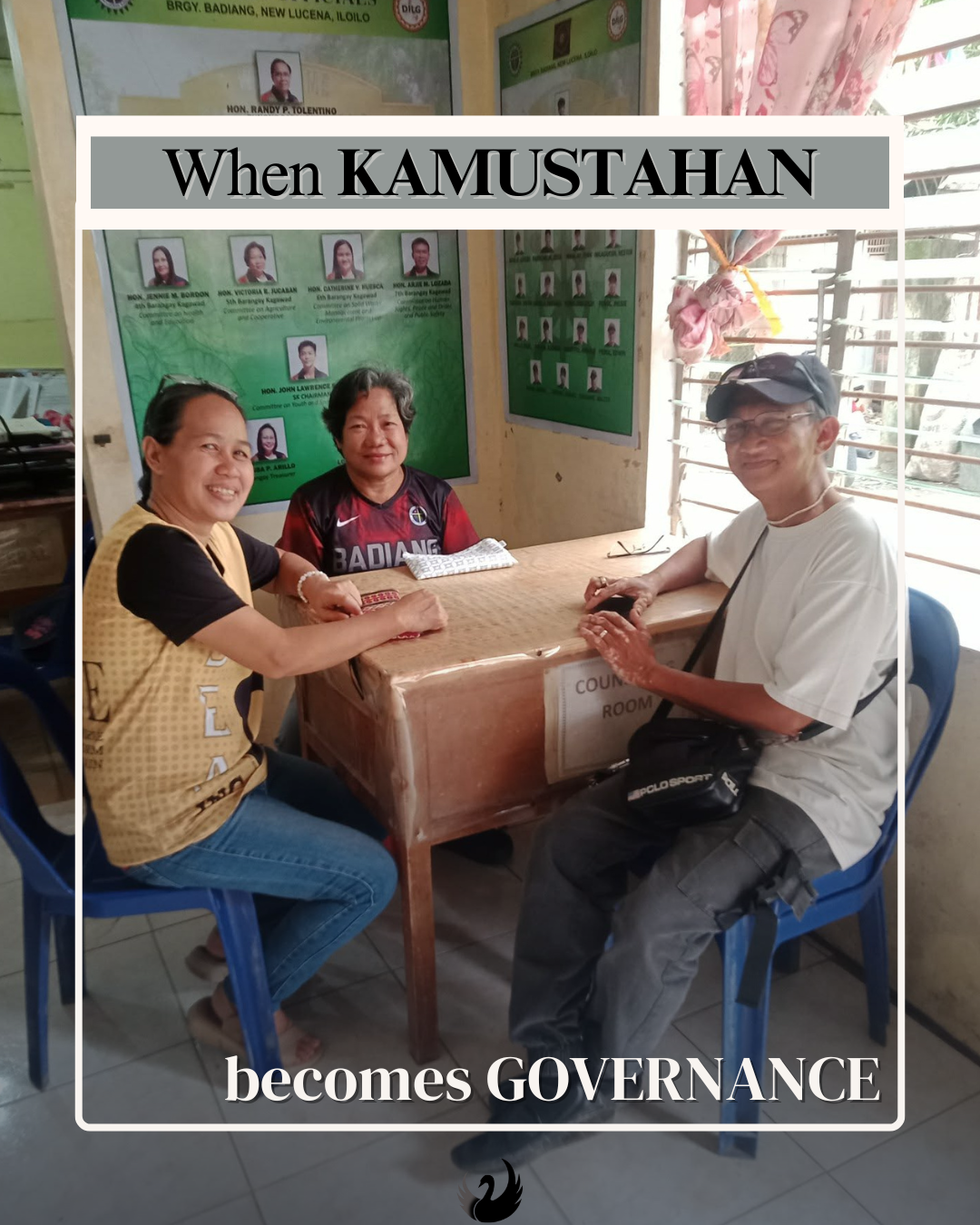
In Barangay Badiang, kamustahan is never just small talk. It is a doorway.
During the Weekly Kamustahan Inner Conditioning Workshop (ICW), participants did not speak in policy language or development jargon. They spoke in gratitude, hope, and hard-earned clarity—reminding everyone in the room that before governance can work outside, it must first be grounded within.
This is the quiet strength of ICW. It conditions the inner life of citizens so that collective action becomes steadier, kinder, and more resilient. And in Badiang, that inner work showed up in stories that felt deeply personal—and unmistakably communal.
For Victoria Jucaban, 2025 was a year that deserved a long pause of thanksgiving
“Isa gid sa dabest nga ginapasalamatan ko sa 2025, nakapasar akon bata sa board exam sa Agriculture.”
Her pride filled the room. A child passing the Agriculture board exam was not just a family victory—it was a promise to the future of food, land, and service. Victoria continued, naming another blessing: the Department of Agriculture’s livelihood support for hog raising.
“Nabaton namon ang livelihood sang DA sa pagsagod sang baboy.”
Livelihood, education, and health—three pillars of dignity—came together in her story. And like many parents, her hopes for 2026 were both simple and profound: stable work for her child, continued good health, and a life that remains modest but secure.
Across the circle, Cornelio Figueroa Jr. offered a reflection that made everyone smile—and think.
“Thankful ako sa 2025 kasi hanggang ngayon buhay pa ako.”
It was said lightly, but it landed deeply. Survival, he reminded everyone, is not something to rush past. Life itself is already an achievement. From there, Cornelio shifted naturally—from the personal to the collective.
He spoke of challenges faced and solved, and of a barangay that is steadily turning plans into reality.
“Okay na developmental program ng barangay… nasusunod naman ang plano, lalo na ang pag-establish ng Barangay Government Center.”
For him, 2026 is not just another year—it is the peak. A season where projects long discussed finally take shape, where infrastructure reflects intention, and where governance becomes visible in everyday life. And yet, even as he spoke of progress, he remained grounded:
“Enjoy naman ako sa buhay… may problems pero na-overcome.”
Personal healing, family reconciliation, and unfinished dreams—these, too, are part of development.
What unfolded in this ICW session was more than reflection. It was Bayanihan Governance in its most human form.
Through SEA’s approach, governance is not reduced to meetings and mandates. It begins with people who are emotionally grounded, grateful, hopeful, and ready to take responsibility—not just for projects, but for one another. When citizens learn to listen to themselves and each other, collaboration becomes natural. Trust becomes possible. Participation becomes sustainable.
In Brgy. Badiang, gratitude for a child’s success, a livelihood opportunity, a functioning barangay plan, or simply the gift of being alive all point to the same truth: development works best when it is shared, rooted, and deeply felt.
The Weekly Kamustahan ICW reminds us that before communities can build centers, programs, or systems, they must first build inner readiness. And when that happens, bayanihan is no longer just a value—it becomes a daily practice.
As Badiang looks ahead to 2026, one thing is clear: with citizens who are grounded within and connected with one another, governance does not just move forward—it moves together.

Leave a Reply