
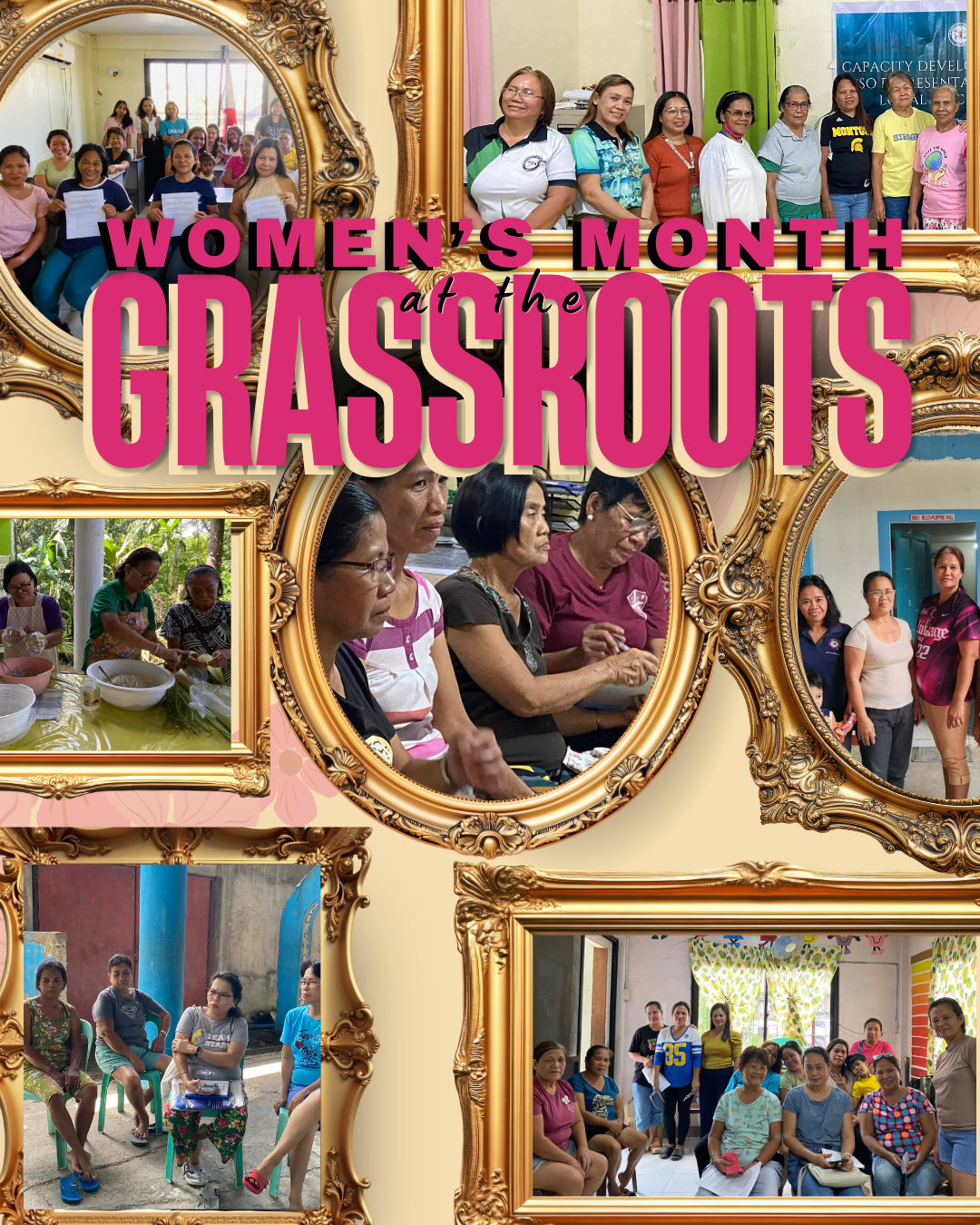
Every March, the world turns its attention to women. There are hashtags, speeches, conferences, and celebratory posts. But far from the bright lights of formal stages, there is another Women’s Month unfolding quietly—in barangay halls, daycare centers, coastal clean-ups, farmers’ meetings, and community assemblies.
Here, Women’s Month is not just a celebration.
It is a continuation of work that never really stopped.
At the grassroots, women are not only participants in development. They are often the steady hands holding the entire community together.
The single mother who attends a barangay assembly after a long day’s work.
The women’s organization leader who mobilizes neighbors for disaster preparedness.
The volunteer who reminds everyone that transparency in governance matters.
The community health worker who walks house to house ensuring no child is left behind.
These women rarely appear in headlines. Yet their impact shapes the everyday realities of local governance and sustainable development.
As Margaret Mead once said, “Never doubt that a small group of thoughtful, committed citizens can change the world. Indeed, it is the only thing that ever has.”
Grassroots women embody this truth. Change often begins not in grand halls of power, but in small community meetings where women ask difficult questions:
Where is the budget going?
How can we protect our environment?
How do we make sure everyone’s voice is heard?
These questions are not merely administrative. They are acts of courage.
Women at the grassroots understand governance in the most practical way possible: not as theory, but as everyday life. Governance determines whether clean water reaches homes, whether public funds are used properly, whether disaster risks are reduced, and whether future generations will inherit a livable environment.
When women step into leadership roles in communities, something quietly shifts. Conversations expand. Priorities become more inclusive. Development becomes more grounded in real needs.
This echoes the words of Kofi Annan, former UN Secretary-General: “There is no tool for development more effective than the empowerment of women.”
Empowered women do not only uplift themselves—they strengthen institutions, nurture civic participation, and anchor sustainability efforts within communities.
Yet grassroots women leaders often balance multiple roles at once: caregiver, worker, volunteer, organizer, and advocate. Leadership for them does not come with large offices or titles. Sometimes it comes with borrowed chairs in barangay meetings, handwritten notes, and determination stronger than the challenges they face.
Their leadership is practical. Their governance is relational. Their sustainability efforts are deeply rooted in lived experience—protecting rivers because their children drink from them, ensuring transparency because they understand the cost of corruption, advocating participation because they know exclusion too well.
Michelle Obama once said: “There is no limit to what we, as women, can accomplish.”
At the grassroots, women prove this every single day.
They build bridges between citizens and government.
They turn advocacy into action.
They remind communities that democracy works best when people participate—not just during elections, but in everyday decision-making.
Women’s Month, therefore, should not only celebrate women’s achievements. It should also recognize the everyday labor of women who continue to build stronger communities quietly and persistently.
For grassroots women leaders, empowerment is not abstract. It is attending another meeting even when tired. It is speaking up even when voices shake. It is believing that communities deserve better governance and a sustainable future.
Their leadership may be humble. Their platforms may be small. But their impact is profound.
Because in every barangay where women organize, advocate, and serve, democracy grows stronger.
And perhaps the real meaning of Women’s Month is this:
Not simply honoring women once a year—
but recognizing that communities move forward every day because women keep showing up.
Quietly. Persistently. Powerfully.


Leave a Reply